

What Usually Goes Wrong First
Most failed zero threshold shower installations on wood subfloors share a common origin: the waterproofing was either rushed or undersized. Water finds every gap, every pinhole, and every unsealed penetration. On a concrete slab, a small leak is annoying. On a wood subfloor, it causes rot, mould, and structural damage within 12 to 18 months.
The case for careful planning is not hypothetical. Contractors who have had to tear out a two-year-old shower because the subfloor failed learn this lesson once and never repeat it.
What a Proper Installation Requires
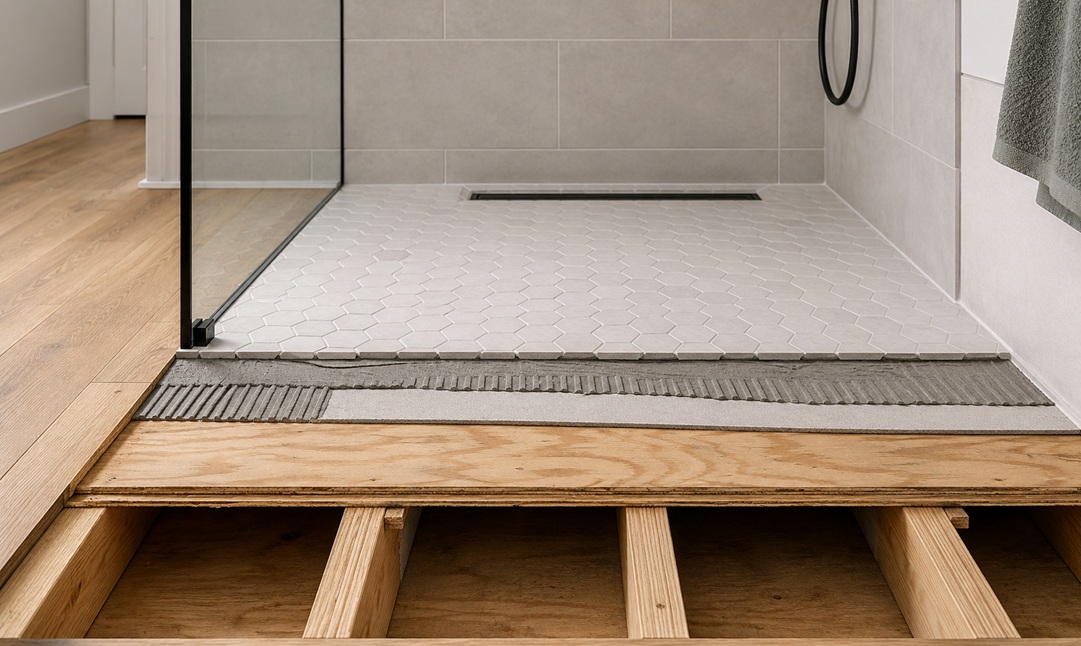
Subfloor depression: A zero threshold shower must sit flush with the surrounding bathroom floor. That means the shower assembly — drain, pan or liner, mortar bed, tile — all needs to fit within a recessed area. Standard framing must be cut down or sistered to drop the floor by 1.5 to 2 inches. This is structural work that should involve a licensed contractor or structural assessment if you are unsure about joist placement.
Rigid substrate: The subfloor beneath the shower must be solid. Standard 3/4-inch OSB or plywood is not enough on its own. Most installations require a second layer, cement board, or a pre-sloped foam shower pan system rated for wood subfloors. Flex in the floor causes grout cracks and liner failures.
Waterproofing membrane: This is non-negotiable. Use a sheet membrane like Schluter Kerdi, a liquid-applied membrane, or a foam pan that is bonded and waterproofed. The membrane must extend up the walls by at least 6 to 8 inches. Every penetration — drain collar, pipe, fastener — must be sealed.
Slope: The floor must drain consistently. A 1/4-inch drop per foot toward the drain is standard. With a linear drain along one wall, the entire floor slopes toward that single edge. With a centre drain, all four sides slope inward. Getting this right in a recessed wood frame takes precise planning before the cement board goes down.
Lessons From Real Projects
A linear drain installation tends to work better on wood subfloors than a centre-drain configuration, because the framing depression needed is simpler — one straight channel cut rather than a pyramidal drop across the whole shower area.
Pre-sloped foam shower pan systems designed for wood subfloors (brands like Wedi, Laticrete Hydro Ban, or Schluter) have simplified this significantly. They bond directly to the subfloor, are lightweight, and provide an integrated waterproofing layer. They cost more than a traditional mortar bed, but they substantially reduce the risk of liner failure.
Key Recommendations
If you are tackling this as a DIY project, research your local building codes first. In the US, many jurisdictions require a permit for structural subfloor modifications. In the UK, any structural bathroom work typically falls under building regulations. Australia requires similar approval in most states.
Hire a licensed plumber for the drain rough-in. This is the single penetration point most likely to fail if poorly done. Everything else — tile, membrane, slope — can be verified visually. A bad drain collar is invisible until it is a problem.
