

Three brass candlesticks, two ceramic birds, a copper kettle, and a framed oil painting of a landscape you can’t quite identify. Put them all on one shelf and your living room starts to feel like a booth on a Sunday morning. That’s the trap. Vintage pieces have personality, so when you pile them together without a plan, each one fights the others for attention.
The fix isn’t buying less. It’s choosing a small number of anchors and letting everything else support them. I’ve styled more than a few rooms with secondhand finds, and the rule that saves every one of them is simple: pick the hero, then dress the room around it. You’ll know you’ve got it right when a guest spots the one thing you love first and notices the rest only on a second pass.
That’s why I lean on a curated mix like the vintage home decor collection at Urban Americana when I need a baseline. Seeing a real inventory, with real prices and scale, sharpens your eye faster than any mood board.
Why does vintage decor go wrong so fast?
Because every vintage object already has a voice. A 1950s swung glass vase is loud. So is a walnut table lamp with blue stained glass. Put four loud things in a five foot space and the eye has nowhere to rest. It reads as clutter even when each piece is beautiful.
New furniture from a catalog is the opposite problem. It’s quiet by design, built to match, which is why a room made entirely of showroom pieces feels like a hotel lobby. That’s the real argument for mixing eras. You need a few objects with a point of view, and you need the discipline to stop at three or four.
Designers have understood this for decades. The mid-century modern movement that a lot of today’s best finds come from was a deliberate break from heavy ornament, and organizations like the Smithsonian Institution have spent years documenting how that shift changed the American home. Looking at how those rooms were actually put together is free education. Study them before you shop.
The anchor-first framework
Here’s the method I use, and you can run it in an afternoon. I call it anchor, field, and echo.
| Layer | What it is | How many |
|---|---|---|
| Anchor | The statement piece your eye lands on first: a signed oil painting, a big mirror, a lamp with real presence | One per room |
| Field | The quiet furniture and surfaces that hold the room together | As many as the space needs |
| Echo | Small repeats of the anchor’s color or metal, scattered at eye level | Two or three |
Start with the anchor. If you’re buying from a collection page, sort by price high to low first and look at the top of the list. Those are the pieces with the most presence, like a pair of walnut Modeline table lamps or a large framed landscape. You don’t have to buy the most expensive thing. You just need to see what a hero looks like before you decide yours is a $120 swung vase on a bare mantel.
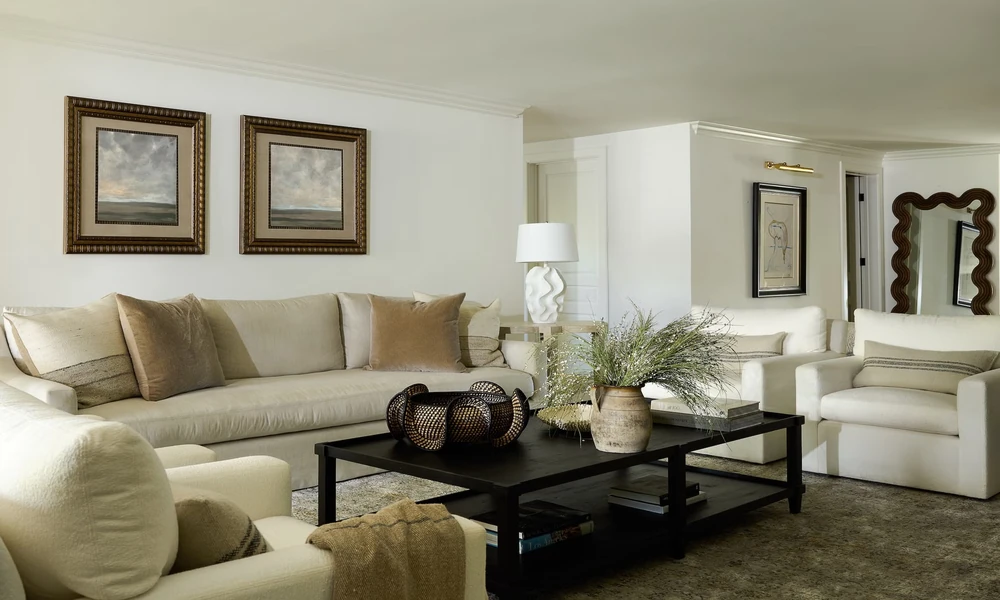
Field pieces should recede. A neutral sofa, a simple wood console, plain walls. The whole job of the field is to give the anchor room to breathe, and most people skip this step and then wonder why the room feels tight. It’s tight because everything is at the same volume.
Echoes are where the room starts to feel intentional. If your anchor is an amber vase, pull that warmth into a second spot across the room: a brass tray, a rusty orange book spine, a small ceramic bowl. Two or three repeats read as a color story. Five read as a theme park.
A quick checklist before you commit
- Stand at the doorway. Can you name the anchor in three seconds? If not, remove something.
- Check the height. Vintage decor lives at eye level. If everything on a wall sits at the same height, vary it.
- Leave negative space on every shelf. Bare shelf space is part of the design, not a failure.
- Mix materials on purpose. Glass next to ceramic next to wood next to metal, not five glossy things in a row.
- Photograph the vignette. A phone photo exposes imbalance better than your eye does.
One more thing worth saying out loud: don’t buy a matching set of anything vintage. The charm is in the slight mismatches. A collection with a mid-century Italian ceramic pig sitting next to a Danish glazed dish works precisely because they don’t belong to the same family.
Where to shop and what it costs
Secondhand is genuinely cheaper than it used to be relative to new furniture, and the resale economy behind it is enormous. According to the Bureau of Labor Statistics, retail trade employs millions of Americans across thousands of storefronts, and the secondhand and antique segment has grown into a meaningful slice of that. You’re not hunting through a fringe market anymore.
Set a budget before you browse, because vintage shopping punishes impulse. I’d spend the bulk of it on the anchor and almost nothing on the echoes. A $350 signed landscape will do more for a room than ten $35 knickknacks, and the painting won’t end up in a donation box in two years. When you sort an online collection, that price range is your fastest filter. Shop the hero tier first, then come back for the small stuff.
Practical concerns matter too. Old lamps need rewiring, old frames need new backing, and glassware should be packed with real care in transit. The Environmental Protection Agency has long made the case that keeping goods in use and out of the waste stream carries real benefit, which is a nice bonus on top of the look. Just budget a little time and money for repairs instead of pretending they won’t come up.
The mistake I see most
People treat vintage decor like a shopping problem when it’s really an editing problem. The room that looks collected, the one you walk into and feel something, usually has fewer objects than the room next door. Fewer, bigger, better.
So buy the one piece that stops you. Display it with air around it. Then let two or three small echoes carry its color to the other side of the room. That’s the whole method, and it works in a studio apartment as well as a house.
What’s the one object in your home you’d build a room around?
