

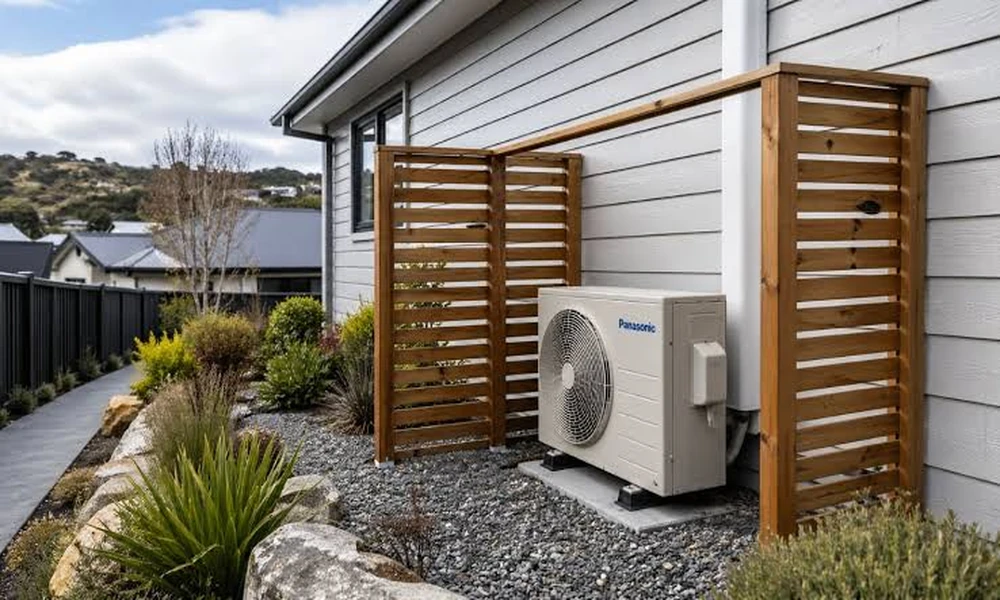
It’s the third week of July in Chandler, the outdoor unit is humming but the house is blowing warm air, and your thermostat reads 84 and climbing. That is the moment your day stops being about anything else.
Here’s the honest part most HVAC guides skip: half the calls that look like emergencies at 9 p.m. turn out to be a tripped breaker or a clogged filter, and the other half get worse the longer you wait. Knowing which one you’re standing in front of saves you money, saves a technician a midnight trip, and gets your house cool a whole lot sooner. This piece walks you through both sides.
Before you dial anyone, run the five-minute check below. If it comes up empty and the compressor is dead in the middle of a heat wave, that’s when you start looking for emergency heat pump repair in the East Valley and get a real technician on the line.
First, run the five-minute check
You don’t need tools for this. You need patience and a flashlight.
- Breaker panel: Find the double-pole breaker feeding the outdoor unit. If it’s tripped, flip it fully to OFF, then back to ON. If it trips again, stop. That’s a technician’s problem.
- Filter: Pull the return-air filter. A filter packed with dust chokes airflow, and a heat pump low on airflow can ice its coil and quit cooling.
- Outdoor unit: Look for ice on the copper lines or the coil. If you see it, switch the system to OFF and call a pro. Running a frozen heat pump makes things worse.
- Thermostat: Check the batteries and make sure it’s set to COOL, not HEAT or OFF. Sounds dumb. You’d be amazed how often this is the whole fix.
- Float switch: Many air handlers have a condensate float switch that shuts the system down when the drain pan fills. A quick vacuum of the drain line can free a clog.
If all five pass and the house is still hot, you are now in genuine emergency territory. Good. You’ve earned the call.
What actually separates an emergency from a soon fix
A heat pump that stops cooling in mild weather can wait a day. A heat pump that quits when the outside temperature is over 100 degrees with a toddler, an elderly parent, or a dog in the house is a different animal. The real risk isn’t just discomfort; it’s heat illness, and that’s when the urgency is legitimate.
A few signs that mean call now, don’t wait: outdoor unit is dead quiet with no fan spinning, indoor unit blows nothing at all, a burning smell, a breaker that trips repeatedly, or a compressor making a hard metallic clatter. Any of those and you skip the do-it-yourself routine and call the after-hours line.
Signs that mean you can probably wait until morning: weak airflow that’s still cool-ish, a system short-cycling every few minutes, or an outdoor unit running but not dropping the indoor temperature as fast as it used to. Those get you on a regular service call, which is cheaper and easier to schedule.
Why East Valley summers push heat pumps harder than most places
Our climate is brutal on this equipment. The U.S. Department of Energy puts it plainly in its heat pump guidance: a heat pump moves heat rather than making it, which makes it efficient in typical conditions, but extreme outdoor temperatures push the system to work near its capacity for weeks at a stretch. Here in the Valley, “weeks at a stretch” is more like five months.
That matters for what wears out and what fails. Compressors, capacitors, contactors, and fan motors see constant load all summer. A capacitor that would take years to fail in a milder climate can die in a single season here. So if your unit is older, remember that breakdowns aren’t bad luck; they’re the predictable end of a part doing its job under extreme pressure.
Who actually answers a heat pump emergency in the East Valley
This is where most homeowners get burned. Two in the morning with no AC, you call the first company that shows up in a search, and you find out the emergency line forwards to an answering service and the first real technician is 14 hours out.
Here’s how to tell a real emergency response from a marketing line. Ask two questions on the phone: “Is a technician actually on call tonight, and roughly how long until one reaches my house?” If the person on the phone can’t answer either, you’re talking to a dispatcher, not a crew. A legitimate Valley shop that runs an after-hours emergency service will tell you a dispatch window and confirm coverage in your part of town.
It’s also worth asking whether the tech can handle heat pump-specific parts. Heat pumps use different reversing valves, defrost boards, and refrigerant circuits than straight AC. A tech who mostly does AC work can get your house cool, but the fix may not hold through the next cold snap, when the heat pump has to run in reverse.
A practical prep list before you ever need it
The best time to solve an emergency is three months before it happens.
- Book a seasonal tune-up in spring, not during the first triple-digit week, when every tech in the Valley is already underwater.
- Keep the name and after-hours number of a reputable local company on your fridge. If your search engine is your only safety net, you’ll pick based on ads, not quality.
- Replace your filter every 30 to 60 days in summer. In a dusty East Valley home, closer to 30.
- Clear two feet around the outdoor unit. Pull the weeds, move the garden hose reel. Restricted airflow is a self-inflicted problem.
- Ask about compressor and parts coverage on your system. Knowing what’s under warranty changes how you think about repair versus replacement.
One more: if your heat pump is 12 to 15 years old and this is the second major repair this summer, get a quote for replacement while it’s still working. The EPA’s ENERGY STAR guidance is clear that replacement decisions get much easier when you’re not standing in a 95-degree house begging for a fix.
What a fair emergency call should look like
A legitimate after-hours call starts with a diagnostic fee you’re told about upfront. No one should show up at your door with a mystery price. The tech should explain the diagnosis, show you the failed part if you ask, and quote both the repair and any options in writing or over text before turning a wrench. If you get silence, pressure, or a bill that appears out of nowhere, hit pause.
The Bureau of Labor Statistics lists heating, air conditioning, and refrigeration mechanics among the trades that require formal training and licensing, so ask for the license number. It’s not a rude question; it’s a smart one.
Heat pumps rarely fail with a warning. What you can control is the five-minute check, the phone number on your fridge, and the questions you ask before a tech walks in the door. Run the check. Ask the questions. And if the air’s still warm and everyone’s miserable, call a company that actually answers at 11 p.m., not one that just advertises it.
